
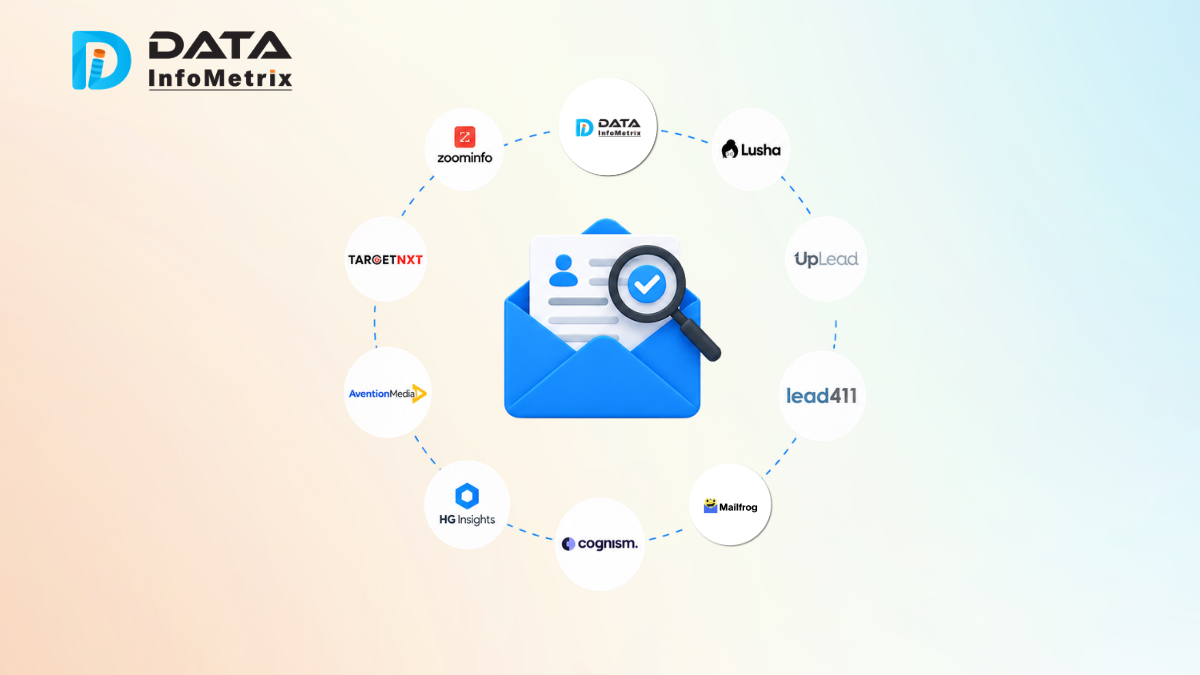
In 2026, the most expensive mistake a B2B marketer can make isn't a bad creative or a weak subject line; it is hitting "send" on a database that was outdated before it even reached their CRM. While every provider in the market promises a "verified" list, the reality is that B2B data is decaying faster than ever, often at a rate that turns a standard spreadsheet into a liability within weeks. If you are targeting users of specific platforms like cloud infrastructure, CRM systems, or specialized healthcare software, you aren't just looking for names; you are looking for a verified technical footprint that confirms a buyer is active, reachable, and relevant.
The challenge lies in cutting through a sea of identical claims where "accuracy" has become a buzzword rather than a guarantee. This guide is built to solve that problem by identifying the top players who are actually redefining data integrity this year. We have analyzed the market to identify providers that prioritize live signals and human-verified precision over bulk-scraped noise. When you are at the edge of this blog, you will have a clear picture of the industry’s best data sources, a specialized verification layer that helps convert bounced emails, and the global compliance that will help you stay secure in this highly regulated market.
What Is a B2B Technology Customer List, and Why Does It Work Differently?
Let’s try to understand this with a small example. You are selling a tool that integrates with Salesforce or AWS, such as a data enrichment add-on or a specific CRM feature. A broad list of “IT Managers” is basically a generic list, cause you aren’t looking for a job title, you are looking for those whose current infrastructure already fits your solution.
That's the gap a technology customer list fills.
It's a verified database of companies using specific technology platforms, Salesforce, AWS, SAP, Shopify, AthenaHealth, and many others, paired with verified contact details for decision-makers within those organizations. The technology used filters the audience before a single email goes out.
What makes it different from a standard B2B contact list is the technographic layer. Instead of filtering by industry and job title alone, a technology customer list confirms which platforms a company is actively running. That one data point tells you far more about a company's priorities, budget allocation, and buying behavior than its industry classification ever will.
A company running Salesforce Sales Cloud is a different buyer from one running Salesforce Marketing Cloud. A company using AWS Lambda for serverless architecture is a completely different conversation from one running basic EC2 compute. The platform is the signal, and the module or service they run is the targeting precision.
Done right, a technology customer email list doesn't just get you into more inboxes. It gets you into the right inboxes, with something relevant to say before you start.
The Real Cost of Getting Technology Customer Data Wrong
Before comparing providers, it’s worth being honest about why this market is more challenging than it looks.
B2B contact data changes frequently. This happens because people change jobs, companies merge, platforms change, and most email addresses go stale. Data rot is a real problem, and most providers don’t even update their databases on time to keep up with it.
This shows an effect on the campaign: it looks engaging on paper but produces high bounce rates, poor deliverability, wasted sales team time, and, in some scenarios, damage to senders' reputations.
For technology customer lists specifically, there’s an additional layer of complexity. A company that appeared in a Salesforce customer success story two years ago may have since migrated to HubSpot. Without live verification of active platform usage, the list you’re buying may be largely irrelevant before you even open it.
This is the challenge that the best providers in this space have solved, and separates them from the rest.
What to Look for in a B2B Technology Customer List Provider
Not all the data providers are built for a technology customer list. Let’s see the difference between the ones that claim to be that:
1. Live technographic verification, not historical data
These are the providers that confirm platform usage through live signals, active job postings for platform-specific roles, technology integration footprints on company websites, and real-time software tracking tools. Providers relying on vendor-published customer lists or old directories are selling you historical association, not current usage.
2. Data freshness and refresh cycle
Ask any provider: how often do you re-verify your records? The industry average sits around six weeks, which is too slow for technology data, where platform migrations and role changes happen continuously. The best providers run ongoing re-verification, not periodic batch updates.
3. Contact depth beyond name and email.
A generic list only includes name and email address. But a verified technology customer list includes detailed data fields such as direct dials, LinkedIn URLs, job titles, firmographic details, specific modules or services the company is actively running, etc.
4. Compliance, and the ability to prove it
GDPR, CCPA, CAN-SPAM, and CASL are the baseline. For healthcare technology lists, HIPAA alignment is non-negotiable. Any technology data provider should be able to keep their data sourcing practice transparent, explain compliance with opt-in requirements, and also provide a Data Processing Agreement without hesitation. If they fail to fulfill these things, then walk away.
5. Custom builds vs. pre-packaged lists.
Pre-packaged lists are sold to multiple buyers at the same time. A custom-built list is assembled from scratch around your exact ICP, industry, geography, company size, technology product, role, and seniority. For technology customer data, the difference in campaign relevance is important. Custom builds win every time.
Top 10 B2B Technology Customer List Providers in 2026
1. Data InfoMetrix
At Data InfoMetrix, we specialize exclusively in custom-built B2B technology customer lists. Every list we build starts from scratch based on your specific targeting criteria, not pulled from a shared database that’s already been sold to multiple buyers before it reaches you.
Best for: B2B teams targeting companies that use a specific technology platform and need verified, role-level contacts with actual technographic depth, not a broad list of technology users.
Key strengths:
- Technology usage verified through live signals, job postings, integration footprints, and platform-specific digital data, not outdated vendor directories.
- 80+ data fields per record, including the specific module or product in active use
- Human verification combined with AI-assisted processing on every contact record
- 98% accuracy guarantee, records that don't meet benchmarks after delivery are replaced at no cost
- Covers 50+ platforms, including Salesforce (salesforce-crm), AWS, Shopify, and AthenaHealth
- Free sample before purchase, built around your actual targeting criteria, not a generic demo
Compliance: GDPR, CCPA, CAN-SPAM, CASL, HIPAA-aligned, 13+ global frameworks
One thing to note: Data InfoMetrix uses a custom-built model rather than a self-serve platform. You work directly with their data team to define criteria and receive a campaign-ready list. It takes slightly longer than a self-serve export, but the targeting precision consistently produces better results.
2. ZoomInfo
It’s one of the widely used B2B contact data platforms that covers 500M+ contacts with org chart mapping, buyer intent signals, technographic data, and deep CRM integrations. It’s built for the marketing and sales team who want prospecting, insights, and outreach all in one place.
Best for: Enterprise team with a structured budget and needs deep account mapping and specific signals in a single platform.
Key strengths:
- 500M+ contacts with org chart mapping and buyer committee visibility
- Technographic data covering thousands of technology products
- Intent data and real-time trigger alerts, funding, hiring, and technology adoption
- Strong native integrations with Salesforce and HubSpot
Compliance: GDPR, CCPA, and DPA (On request)
One thing to note: Pricing of the email list data starts at $15,000+/year with multi-year contracts. A specialist custom-built provider will provide a detailed technographic accuracy for a highly specific module-level or service-level platform.
3. TargetNXT
TargetNXT builds custom email lists rather than selling from a shared database, with 700M+ B2B contacts, 15+ compliance frameworks, and 41-day update cycles.
Best for: B2B teams who need custom-built technology user lists with no subscription or contract commitments and multi-channel contact coverage.
Key strengths:
- Custom list building, no shared, pre-packaged databases resold to multiple buyers
- 700M+ contacts with 41-day update cycles and SMTP and NCOA verification
- Multi-channel coverage including email, phone, and direct mail
- No contracts, flexible, campaign-based purchasing
Compliance: Aligned with 15+ global and regional data privacy standards.
One thing to note: TargetNXT provides a huge range of technology categories. Before purchasing a customer list, always request a data sample to validate technographic accuracy for your exact use case.
4. Avention Media
Avention Media provides users' email lists in both pre-packaged and Customizable Formats. They are globally covered, providing 50+ data fields and multi-channel contact data.
Best for: Those B2B marketers who are in need of contact data for technology professionals across multiple industries and geographies, with flexible customization options.
Key strengths:
- Pre-packaged and custom email list options.
- 50+ data fields
- Multi-channel data provider
- Globally covered across North America, Europe, and the Asia-Pacific.
Compliance: GDPR and CAN-SPAM compliant; permission-based sourcing
One thing to note: If you are targeting a broad technology category, then a pre-built option works well. And a specialist, custom-built data provider will be needed if you are targeting module-level or service-level accuracy.
5. HG Insights
HG Insights is a technographic data platform that focuses on technology install base data, actively tracking technology usage, cloud spending levels, and global infrastructure investment.
Best for: Sales and marketing enterprise teams running ABM campaigns, competitive displacement plays, or territory planning that requires depth in technology installation data.
Key strengths:
- Deep technographic data tracking thousands of technology products globally
- Cloud spend indicators and infrastructure investment signals
- Industry-specific technology adoption breakdowns for whitespace analysis
- Strong use case for competitive displacement and installed base selling
Compliance: Enterprise-grade compliance; DPA available
One thing to note: HG Insights is not a traditional contact list provider; it’s a technographic insights platform. It guides you by showing which companies use which technologies. Getting paired with the right contact data provider gives you insight into the outreach.
6. Cognism
Cognism provides B2B contact data with particular strength in EMEA markets, phone-verified direct dials, strong GDPR compliance, and technographic and intent data filters.
Best for: Enterprise teams doing compliant outreach in EU and EMEA markets where data sourcing standards and privacy regulations differ from the US.
Key strengths:
- Phone-verified 'Diamond Data', the highest available standard for direct dials
- Best GDPR compliance posture in the category, documented legitimate interest basis.
- Strong UK, Europe, and international market coverage
- Technographic and intent data filters included
Compliance: Industry-leading GDPR compliance with documented legitimate interest basis
One thing to note: Enterprise pricing reflects the quality. For teams primarily targeting US technology users on a tighter budget, more cost-effective options are available. Cognism's real differentiator is the quality of its EMEA compliance.
7. Lead411
Lead411 is a B2B sales data platform. It helps sales teams across every organization identify which companies are actively in buying mode, rather than just creating static prospect lists, by combining verified data with ideal signals and growth triggers.
Best for: Sales teams that are not only identifying who to reach but also which companies are actively researching solutions, focusing on behavioral triggers such as hiring surges, funding rounds, and technology adoption signals.
Key strengths:
- Unlimited exports on most plans, no per-contact credit system.
- Buying signal and trigger data across 30+ signals
- Verified direct dials and numbers with US coverage
- Technographic filters for technology stack targeting
- Built-in email outreach sequences
Compliance: GDPR and CCPA compliant; SOC 2 Type II certified
One thing to note: Lead411's real differentiator is the trigger-and-intent layer, not the raw database size. If your team primarily runs high-volume cold outreach without a trigger-based strategy, the platform's best features won't get fully used. It performs best for sales teams that can act quickly on buying signals when they appear.
8. UpLead
UpLead is a B2B prospecting platform built around data quality, real-time verification at the point of download, technographic filters, and a genuine accuracy guarantee with credit replacement for invalid emails.
Best for: SMB and mid-market teams that prioritize data accuracy and want month-to-month flexibility without enterprise contract commitments.
Key strengths:
- Real-time email verification at the point of download, not post-purchase
- Technographic filters for technology stack targeting
- Genuine accuracy guarantee, credits refunded for invalid emails, no questions asked
- No long-term contracts required, flexible monthly plans available
Compliance: GDPR and CCPA compliant
One thing to note: UpLead is ideal for targeted campaigns, not for mass outreach. It’s built for quality over volume. The contact volume on lower-tier plans may feel limiting for very high-volume, platform-specific technology outreach.
9. Lusha
Lusha is built for in-workflow contact discovery rather than bulk list building. It gives real-time B2B contact data with strong LinkedIn integration.
Best for: Sales-led teams where reps mostly spend time on LinkedIn and want quick access to verified emails and direct contacts without the disruption in their existing workflow.
Key strengths:
- Clean LinkedIn Chrome extension, contact reveals without switching tools.
- Real-time database updates and job change alerts
- Intent data included alongside contact data
- ISO 27701 certification: The highest international privacy standard
Compliance: ISO 27701 certified; GDPR and CCPA compliant
One thing to note: Lusha works best alongside a specialist technology customer list provider. Use it for individual contact discovery and a custom-built provider for bulk platform-specific targeting at scale.
10. Mailfrog.io
Mailfrog.io is an ICP-first outbound data platform built by the Avention Media team, combining custom data generation and email campaign execution in a single unified workspace. Rather than selling pre-built static lists, Mailfrog builds a fresh, purpose-built database around your ICP on demand, then lets you run email sequences from the same platform without switching tools.
Best for: B2B revenue teams who are tired of the disconnected stack, buying data from one provider, exporting it, then uploading it into a separate email tool with arbitrary pricing tiers. Mailfrog is built specifically for teams that want to go from ICP to active conversations without leaving the platform.
Key strengths:
- ICP is the command center for data creation, messaging, and campaign logic, rather than an afterthought.
- Custom Data Engine builds fresh, purpose-built contact data on demand, with no recycled inventory sold to multiple buyers simultaneously.
- Unified platform bridges data generation and email sequencing in one workspace, eliminating the import/export cycle most teams are stuck in
- workspace, eliminating the import/export cycle most teams are stuck in
Compliance: Permission-based data sourcing; GDPR and CAN-SPAM aligned
One thing to note: For teams willing to adopt early, the ICP-first model and unified data-plus-sequencing approach is a genuinely different way of doing outbound. For teams that need proven enterprise-scale infrastructure and extensive case studies before committing, it's worth watching closely as the platform matures.
Why Data InfoMetrix Stands Out for Technology Customer Lists
While most providers on this list are designed for general market development and broad outreach, Data InfoMetrix is engineered specifically for technology-driven campaigns. This difference is visible in the technical integrity and structure of our data.
First, every list is a custom build. We don’t filter from the pool of recycled data that has already been sold to other teams or is outdated. Secondly, we verify technology usage through live signals. We track actual job postings for platform-specific roles, analyze integration footprints, and monitor real-time platform activity. We don’t rely on outdated vendors, years-old case studies, or data that is no longer valid or that hasn't reflected the current company’s stack.
Also, our technographic data extends to the module and service levels, moving beyond the simple platform name. There is a massive gap between a company "using Salesforce" and a firm running Salesforce Service Cloud with a footprint of 50+ active users across multiple regions. In the same way, if an organization is “using AWS”, then it’s a broad category, but a company specifically running SageMaker for machine learning infrastructure represents a high-intent, specialized opportunity.
This level of accuracy means your message reaches the exact stakeholders responsible for those platforms, rather than a broad list of contacts who are not currently associated with the brand. Data InfoMetrix covers 50+ major technology platforms, including Salesforce, AWS, Shopify, and Athenahealth, and provides a free sample built to your exact ideal customer profile (ICP) before any commitment is made.
Want to see the data quality before you decide? Request a free sample tailored to your exact platform, ICP, and campaign criteria. No credit card required. (CTA)
How to Choose the Right Provider for Your Situation
The right provider depends entirely on what you're trying to do:
- Targeting companies using specific technology platforms: Data InfoMetrix is built for this use case. Custom-built lists around active installed base data consistently outperform general B2B databases here.
- EMEA outreach with strong compliance requirements: Cognism is the market leader for GDPR-compliant outreach into Europe. The phone-verified data and compliance documentation justify the price for teams selling into EU markets.
- SMBs or startups with limited budgets: Apollo's free tier and UpLead's month-to-month plans provide genuine access without enterprise commitments. Data InfoMetrix also offers free sample data before purchase.
- Enterprise ABM at scale: ZoomInfo's platform breadth combined with HG Insights' technographic intelligence works well for large-scale, multi-signal account-based campaigns.
- LinkedIn-heavy SDR workflows: Lusha sits cleanly inside LinkedIn and is purpose-built for individual contact discovery in that environment.
Conclusion
The technology data market is huge, but the gap between providers with authentic technical verification capabilities and those who just claim to be genuine is wide. For sales and marketing teams targeting companies based on a specific platform, a verified dataset built around usage signals will consistently outperform a generic B2B database. It’s not just written, it’s a fact of every high-performance campaign.
The ten providers covered in this guide represent the full spectrum of the 2026 market, ranging from massive enterprise account mapping platforms to specialized technology list builders. The right choice for your team depends entirely on your target platform, your budget, and the level of technical precision your outreach requires.
Regardless of which provider you choose, one rule remains absolute: Always request a sample built around your actual ICP. You must validate accuracy before committing to a full purchase. Never use database size as a proxy for quality; a provider with a smaller, highly verified dataset will outperform a massive, stale database every single time.
If you are targeting companies using a specific technology and require a verified, custom-built list filtered to your exact criteria, Data InfoMetrix covers 50+ platforms and builds every list from scratch to match your specific requirements.


